A warning is a starting point
Lastfold's fruit offers possible futures. That word possible leaves room for both responsibility and doubt. A recurring vision can demand attention without supplying a complete explanation of what causes it or how to respond.
As you read, keep three questions separate. What has a character observed? What do they believe it means? What do they decide to do because of it? The space between those questions is a useful place to begin discussing the mystery.
- When does repetition make a warning more persuasive, and when might it narrow the questions being asked?
- What would count as taking a warning seriously without treating it as inevitable?
What a map can authorize
Hesta Ruun arrives with a cartographer's discipline and a confidential brief. Oris Tarrow has reasons to keep the orchard out of official hands. Their disagreement brings the practical usefulness of a map into contact with the power it gives to whoever can use it.
Consider the difference between making a place understandable and making it available. A map can guide someone, make a claim legible, or give an institution a way to intervene. Those possibilities need not serve the same people.
- Who benefits when the orchard becomes easier to locate or describe?
- How might a map be accurate while still leaving out something essential about a place?
The costs of expertise
Oris knows the orchard through the work of keeping it alive. Hesta brings methods for observing and testing. Rather than choosing one kind of knowledge as the answer in advance, notice what each makes visible and what each makes difficult to admit.
A useful discussion can begin with the limits a character recognizes in another person's expertise, then ask whether they can recognize comparable limits in their own. Changing a method and surrendering all judgment are different choices.
- What does each character need to learn from the other, and what makes that exchange difficult?
- When does confidence help someone act responsibly, and when does it make correction harder?
Secrecy, trust, and intimacy
The public premise places confidential knowledge alongside a relationship that develops slowly. Oris and Hesta must work together while deciding how much to reveal. Read their cooperation as part of the romance as well as part of the investigation.
Disclosure can change what another person is able to choose. For a book group, it can be useful to distinguish a secret kept for protection from one kept to preserve control, while allowing that a character may not see the distinction clearly at first.
- What does trust require when neither person can offer certainty about the outcome?
- Which forms of practical cooperation matter as much as a declaration or confession?
Work, weather, and responsibility
The orchard is both an extraordinary source of knowledge and a place that has to be tended. Keep the daily work in view alongside the mystery. Caring for something over time can create obligations that an isolated glimpse of the future cannot settle.
- Notice the language of tending, grafting, testing, mapping, and keeping.
- Look for the difference between a decision made for someone and one made with them.
- Track moments when uncertainty changes the scale or timing of a choice.
Questions for a book group
- How does the phrase edge of the map change your expectations of the orchard and the people who seek it?
- What is the difference between having evidence of a possible future and having authority to decide for others?
- How do the investigation and the developing intimacy change the questions you want answered?
- What does the novel invite you to reconsider about the desire for certainty?
These prompts can be used before finishing the novel. If your group discusses later events, agree on spoilers before sharing specific scenes.
Scope and limits
This original companion draws on the novel's approved public premise and avoids major plot disclosures. Its questions invite different readings; they are not manuscript excerpts or a claim to the novel's single correct meaning.
Explore the book
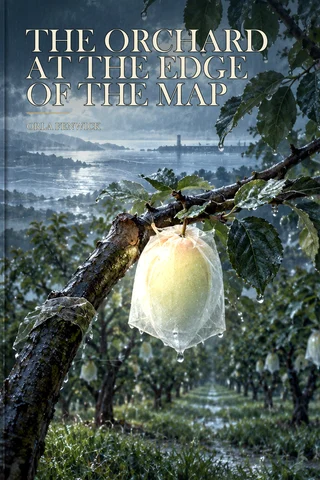
The Orchard at the Edge of the Map by Orla Fenwick is published by Alderwake Press in the Literary & Speculative Fiction line.
About the bookRelated Alderwake resources
Reading companionWhat Maps Include, and What They Leave Out
A spoiler-light companion for reading maps as records, arguments, and instruments that shape borders, witness, accountability, and belonging.
Inherited Knowledge in a Changing Landscape
A spoiler-light companion for thinking about tradition, observation, ecological change, collective survival, uncertain authority, and trust.
Contested Places, Care, and Control
A spoiler-light companion for thinking about unstable boundaries, ecological change, shared responsibility, intimacy, and care without possession.