A way into the landscape
The settlement of Brinehook moves with Emberwake, a mountain whose route has been measured and recited across generations. The premise makes landscape both environment and archive. When the route changes, practical survival and inherited authority become difficult to separate.
Notice how the novel distinguishes observation from interpretation. Water, lichen, forage, maps, and recitation may all carry information, but they do not necessarily tell the community what to do.
Inheritance and revision
- What makes inherited knowledge credible in the community?
- Which parts of tradition preserve attention, and which risk replacing it?
- When does revising a practice honor the people who developed it, and when might revision feel like rejection?
- What does a community owe to knowledge that once worked but no longer explains current conditions?
Observation under pressure
Urgency changes how evidence is evaluated. The need to move, conserve strength, and protect other people can make careful uncertainty look like hesitation, while confidence can look like leadership even when it is poorly grounded.
- Which observations receive attention, and which are discounted because of the observer?
- How does limited time change the standard of proof?
- When is waiting a cautious act, and when does it become its own risk?
Authority and collective survival
- What gives a person authority to interpret a shared danger?
- Where does the novel place the boundary between individual judgment and collective consent?
- How are the costs of a decision distributed among people with different roles or vulnerabilities?
- Can trust survive a decision that cannot promise safety?
Language to return to
- Descriptions of water, lichen, forage, thaw, and the mountain's movement.
- Moments when knowledge is recited, certified, observed, or doubted.
- Scenes where a practical choice also changes a relationship.
- The difference between certainty, confidence, responsibility, and trust.
Book group questions
- Which form of knowledge seemed most persuasive to you, and why?
- Where did a character's responsibility exceed what they could actually know?
- Does the novel treat change as rupture, continuation, or both?
- What would collective survival mean if the community preserved every tradition but lost the ability to observe?
- Which question about trust remained unresolved in a useful way?
Scope and limits
This companion avoids major plot disclosures and offers questions rather than a fixed explanation. Readers can use it before reading for thematic orientation or afterward for discussion.
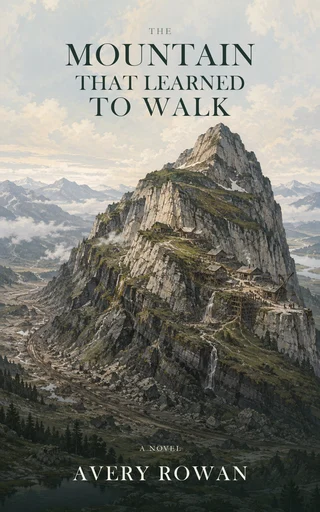
Explore the book
The Mountain That Learned to Walk by Avery Rowan is published by Alderwake Press in the Literary & Speculative Fiction line.
About the bookRelated Alderwake resources
Reading companionWhat Maps Include, and What They Leave Out
A spoiler-light companion for reading maps as records, arguments, and instruments that shape borders, witness, accountability, and belonging.
Possible Futures, Maps, and the Courage to Choose
A spoiler-light way into Orla Fenwick's novel through possible futures, the authority of maps, the limits of expertise, and the work of learning to trust.
Contested Places, Care, and Control
A spoiler-light companion for thinking about unstable boundaries, ecological change, shared responsibility, intimacy, and care without possession.