Begin with the map as an argument
A map includes routes, edges, names, and relationships while leaving other experiences outside its frame. In The Cartographers of Ash, a route that should not exist draws attention to the systems that make one account of a landscape authoritative.
As you read, ask not only whether a map is accurate. Ask what work the map performs, whose movement it enables, and which testimony it can absorb without changing its form.
Maps and records
- Which features of a map appear factual because they are drawn rather than spoken?
- How do revision, correction, and forgery differ in the world of the novel?
- When several records agree, what makes that agreement persuasive or suspicious?
- What cannot be represented at the map's scale?
Borders and belonging
A border can describe a physical limit, a political claim, a memory, or an administrative convenience. Its apparent stability may conceal the labor required to maintain it.
- Who gains security when a border is fixed, and who becomes newly uncertain?
- Does belonging arise from presence, history, recognition, movement, or documentation?
- What changes when the ground and the record tell different stories?
Missing witnesses and accountability
- How can an absent person remain part of an evidentiary record?
- Who is authorized to speak for someone who cannot testify?
- When does correcting a record repair harm, and when does it merely move responsibility elsewhere?
- What would institutional accountability require beyond acknowledging that a map was wrong?
Language to return to
- Passages that distinguish crossing the ground from reading its representation.
- Moments when a correction appears small in form but large in consequence.
- Descriptions of ash, water, borders, routes, and missing people.
- Scenes where professional method becomes an ethical choice.
Book group questions
- Which map or record did you initially trust, and what supported that trust?
- Can a map be wrong without being false? What distinction does the novel make possible?
- Which omission carried the greatest weight in your reading?
- How does the altered landscape complicate the desire for a final, stable account?
- What would a more accountable form of mapping look like in this world?
Scope and limits
This companion uses only the novel's public premise and themes, avoids major spoilers, and does not define a single correct meaning.
Explore the book
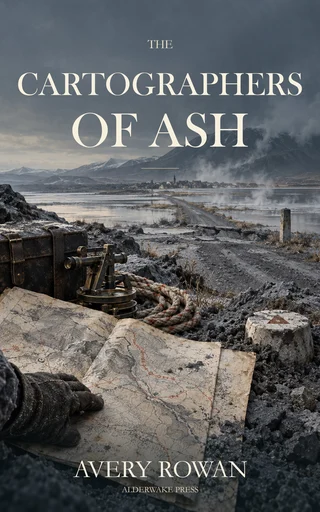
The Cartographers of Ash by Avery Rowan is published by Alderwake Press in the Literary & Speculative Fiction line.
About the bookRelated Alderwake resources
Reading companionRecords, Evidence, and Belonging in The Census of Unlit Stars
A spoiler-light companion for thinking about records, lived reality, evidence, memory, and the uneasy conditions of institutional visibility.
Possible Futures, Maps, and the Courage to Choose
A spoiler-light way into Orla Fenwick's novel through possible futures, the authority of maps, the limits of expertise, and the work of learning to trust.
Contested Places, Care, and Control
A spoiler-light companion for thinking about unstable boundaries, ecological change, shared responsibility, intimacy, and care without possession.